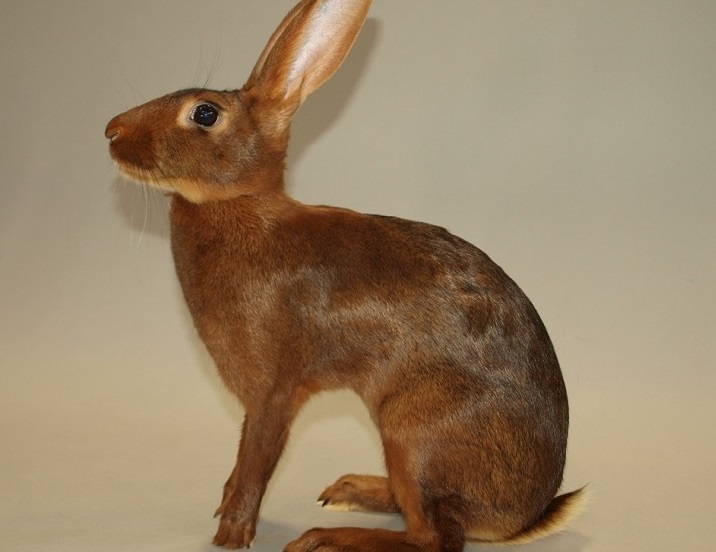
The domestic rabbit breed known as “zaječí” (Za) resembles the European hare in appearance. It weighs about 4.5 kg and has a long, arched body with slender, elongated limbs. It is simply an old domestic rabbit breed that originated in England through long-term selective breeding of meat rabbits originally imported from Belgium. For this reason, it is often known abroad as the Belgian Hare. The zaječí breed is definitely not the result of hybridization (i.e., interspecies crossbreeding), as rabbits and hares do not mate with each other—a fact that has been repeatedly confirmed experimentally.
Rabbit vs. Hare
The order Lagomorpha (sometimes somewhat inaccurately translated simply as “hares”) is a taxonomic group of small mammals. It consists exclusively of herbivorous species and is today largely cosmopolitan in distribution. The above-mentioned order includes two families – Leporidae (hares and rabbits) and Ochotonidae (pikas). While pikas belong to rare and endangered species, selected representatives of the other family have been partially or fully domesticated (the European rabbit) and are bred in captivity. Although hares and rabbits show morphological differences resulting from their evolutionary development, their similar outward appearance often causes confusion among many people today.
Domestication of Rabbits
The domestication of the European rabbit began as early as antiquity, although it is generally considered one of the most recently domesticated species. Roman garrisons and later French monasteries played a significant role in this process. The domesticated species, the European rabbit, has fully adapted to human society and care.
It is estimated that there are approximately 180–200 breeds of domestic rabbits worldwide, differing in size, body shape, type and length of fur, and other characteristics. Rabbits were present in the historical territory of today’s Czech Republic no later than the 15th century, originally as a new game species. However, their domestic breeding and selective improvement were of considerable importance.
In contrast, the European hare has never been fully domesticated. Certain groups of hares used, for example, in game management or research may be partially domesticated, particularly for reproduction and subsequent reintroduction purposes.
Difference Between a Rabbit and a Hare
The European rabbit measures approximately 40 cm in length and reaches a weight of around 2 kg. It has a shorter, more rounded body. Its ears measure only about 8 cm. Originally native to the Iberian Peninsula and North Africa, it can now also be found in the wild in Central and Eastern Europe.
The European hare reaches a length of 50–70 cm and a weight of up to 6 kg. It has a taller build with slender but fast limbs. Its ears are distinctly long, ending in a prominent black tip. It naturally occurs across a wide range of Europe and partly inhabits Asia as well.
Reproductive Biology
The gestation period of a rabbit lasts approximately 30 days (29–32 days). Rabbits live in burrows with complex tunnel systems. The female gives birth there to young that are of the so-called altricial type—hairless, blind, deaf, and unable to regulate their body temperature. After nursing, the doe leaves them in a nest lined with fur and returns only the following day. Rabbits are social animals and live in colonies (one male and several females) with an established hierarchy. They prefer lower elevations and drier climates with sandy soils.
The gestation period of the hare lasts about 42 days, after which the female gives birth to 2 to 5 young. These are of the so-called precocial type—they are fully furred, can see and hear, and have developed thermoregulation. They are able to follow their mother almost immediately from the form, which she makes on the ground surface. Hares are solitary animals and live alone outside the mating season.
“Zaječí” – What Is It?
Související články
19. února 2026
Zveřejnil: Ing. Lucie Humeni
V drobnochovech hospodářských zvířat se často pracuje s menšími objemy krmných směsí. Není proto výjimkou, že chovateli zůstane část granulí nebo sypké směsi i po datu (expirace) minimální trvanlivosti. Lze takové krmivo ještě dále zkrmovat?
10. dubna 2024
Zveřejnil: Ing. Lucie Humeni
Chov zakrslých králíků jako domácích mazlíčků získává stále více příznivců. Nevyžaduje velké množství prostoru a je ideální pro lidi, kteří žijí v menších domácnostech nebo bytech. Zakrslí králíci jsou také velmi přátelští, takže se není čemu divit, že si je lidé vybírají pro tento účel čím dál častěji. Stejně jako u všech zvířat je i…
30. srpna 2022
Zveřejnil: Tým specialistů na chov králíků De Heus
V tomto článku se budeme věnovat několika nemocem králíků – ušnímu svrabu, Tyzzerově chorobě a tepelnému stresu.
24. srpna 2022
Zveřejnil: Tým specialistů na chov králíků De Heus
V tomto článku se podíváme na dvě nemoci – E.coli a enterokolitida
2. srpna 2022
Zveřejnil: Tým specialistů na chov králíků De Heus
V tomto článku se podíváme na dvě časté nemoci králíků myxomatózu a infekční rýmu.
Související produkty
KRÁLÍK ZAKRSLÝ
Kompletní granulované krmivo pro zakrslé králíky s vysokou stravitelností. Obsahuje vysoký podíl vlákniny (vysoký obsah vojtěšky a travních úsušků) a snížený obsah cukru a škrobu. Obsahuje lněné semínko, které má pozitivní vliv na kvalitu srsti. Vhodné pro každodenní krmení. Doporučujeme zajistit králíkům nezávadnou čerstvou vodu a seno.
KRÁLÍK CHAMPION
Krmivo pro výstavní králíky, neobsahuje kokcidiostatika. Unikátní složení významně podporuje kvalitu a růst srsti. Podávejte při přelínávání a minimálně 2 měsíce před zahájením výstavní sezóny.
KRÁLÍK GOLD FORTE
Prémiová krmná směs ideální svým složením pro březí a kojící samice. Pro intenzivní výkrm králíků do období min. 5 dnů před porážkou. Podporuje rychlý růst, zmasilost a výborný zdravotní stav. Obsahuje kokcidiostatikum, čímž snižuje riziko úmrtnosti.
KRÁLÍK KLASIK FORTE
Určená pro výkrm králíků až do doby min. 5 dní před porážkou. Vhodné pro dosažení vysoké zmasilosti a výborného zdravotního stavu. Díky obsahu kokcidiostatika snižuje mortalitu zvířat.
KRÁLÍK KLASIK
Pro celou dobu výkrmu králíků. Podporuje vysokou zmasilost a vynikající chuťové vlastnosti králičího masa. Bez kokcidiostatik.
KRÁLÍK START
Pro mladé králíky od začátku příjmu krmiva do 4–6 týdnů po odstavu. Krmivo pomáhá významně snížit úhyn v období okolo odstavu. Obsahuje zvýšený podíl vlákniny a méně škrobů. Neobsahuje kokcidiostatikum.