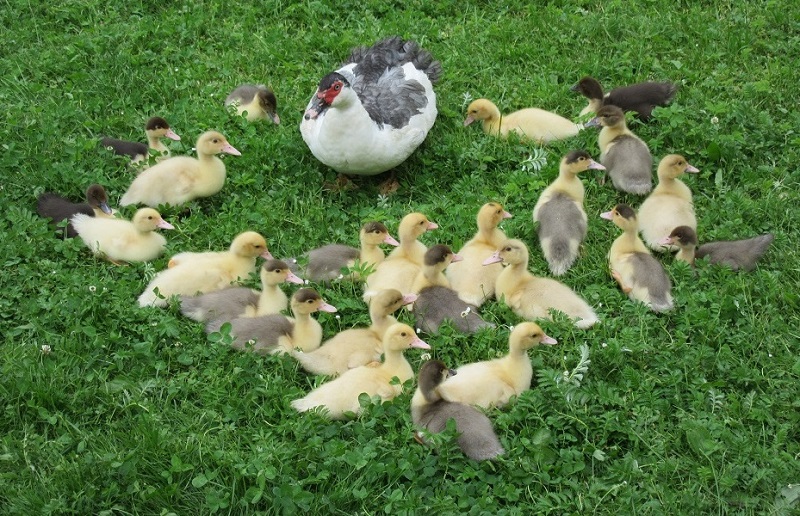
Poultry hatching
In this short article, we will focus on how a breeder should proceed in order to properly select hatching eggs and address other factors that influence the successful hatching of chicks. We will learn how hatching eggs should be stored and how they should be handled. We will also review the incubation periods of individual poultry species and the general conditions for incubation in an incubator.
Spring is a crucial period for every breeder, as it is the season when offspring are obtained from the breeding flock. It is a time full of expectations—whether the selection of breeding animals carried out in the autumn was done correctly, whether the rooster is mating the hens, what the fertility rate of the hatching eggs will be, and subsequently the very important hatchability and vitality of the chicks.
Selection of Hatching Eggs
Breeders should pay close attention to the selection of hatching eggs, as not every egg meets the required attributes. A hatching egg should come from a healthy, well-fed parent flock, have a regular oval shape, a smooth and glossy shell, and appropriate shell color or pigmentation. It is also important to follow the weight limits for hatching eggs specified in the standard of the given species or breed.
Breeders should avoid setting eggs that are deformed, have a noticeably rough shell, are too small, or heavily soiled. It is important to note that both the shape and size of eggs are highly heritable traits passed from parents to offspring.
Storage of Hatching Eggs
Hatching eggs should be stored in a cool room or in a specially adapted refrigerator with a constant temperature. For short-term storage, the temperature may be up to 16 °C. For longer-term storage, a temperature of 8–12 °C is recommended. Maintaining a stable temperature is essential, as fluctuations can weaken the embryo and negatively affect hatchability.
Throughout the storage period, eggs must be turned to prevent the yolk from settling against one side of the shell. For small quantities of eggs, using an automatic turning device may not be practical; instead, a simple 30 cm roof batten can be moved from one side of the tray to the other 2–3 times daily. Goose eggs stored for longer periods should be turned over the pointed end.
The storage period varies depending on the species, which is related to shell quality and porosity. Under proper conditions, goose, duck, or ostrich eggs tolerate longer storage well. In contrast, Japanese quail eggs are not suitable for long-term storage. Generally, the ideal age of hatching eggs is around seven days. If eggs are older than 14 days, embryo viability decreases, embryo mortality increases, and hatchability declines.
If eggs are transported over long distances or delivered by a shipping company, it is advisable to let them rest for one day before placing them in the incubator.
Setting Dirty Eggs
Breeders often discuss whether soiled eggs are suitable for incubation. Such eggs may be used as hatching eggs, but they must be gently cleaned before being placed in the incubator. In practice, coarse dirt can be removed with steel wool, sandpaper, or the rough side of a dishwashing sponge. Washing eggs with water and then storing them is not recommended.
Length of the Incubation Period
The incubation period varies by species. Ostriches have the longest incubation period—42 days. For other commonly kept poultry species, the incubation periods are as follows:
- Muscovy duck – 35 days
- Domestic duck – 27–28 days
- Domestic goose – 27–28 days
- Guinea fowl – 26 days
- Pheasant – 25 days
- Domestic chicken – 21 days
- Quail – 17 days
Incubation Method
Each breeder must decide which incubation method to use. Natural incubation under a broody hen is particularly suitable for waterfowl and turkeys, where the brooding instinct is still preserved. Alternatively, artificial incubation in an incubator may be chosen. This second method is especially suitable for Japanese quail or certain chicken breeds where broodiness is considered undesirable.
Advantages and Disadvantages
The advantage of natural incubation is that the mother will subsequently care for the young. The disadvantage is the limited number of eggs she can brood. Artificial incubation allows for hatching a significantly larger number of chicks, but it requires greater care during rearing.
Incubation Conditions
There are many types of incubators available on the market, each with its own settings specified in the user manual. General incubation conditions for ground-feeding poultry can be defined as follows: the incubation temperature is approximately 37.7 °C, and humidity ranges between 40–45%. During the last two days before hatching, humidity should be increased to 65%.
During incubation, eggs must be turned 2–3 times daily; this step is unnecessary with fully automatic incubators. Egg turning should be stopped 2–3 days before hatching so that the chick can assume the correct physiological position for pipping and hatching.
Související články
5. srpna 2026
Zveřejnil: Ing. Lucie Humeni
Drůbež patří mezi hospodářská zvířata s velmi intenzivním metabolismem (látkovou přeměnou), který je základem její vysoké užitkovosti. Rychlý růst brojlerů, vysoká produkce vajec u nosnic, nebo dobrá reprodukční schopnost chovných zvířat, jsou výsledkem dlouhodobého šlechtění, kvalitní výživy a správného managementu chovu. Současně však tato vysoká výkonnost znamená, že organismus pracuje s vysokými nároky na energii,…
27. května 2026
Zveřejnil: Ing. Lucie Humeni
V praxi malochovů se pojmem grit označuje nerozpustný minerální materiál, který drůbež přijímá za účelem mechanického zpracování krmiva v trávicím traktu. Jde tedy o fyzikálně působící složku, která napomáhá trávení. Typicky se jedná o drobné kamínky (často křemičitý štěrk). Na druhé straně tu máme vápenec (uhličitan vápenatý), který však plní i nutriční funkci, protože je…
2. března 2026
Zveřejnil: Ing. Lucie Humeni
Naklíčené obiloviny jsou jednoduchým způsobem, jak obohatit krmnou dávku především u drůbeže. Díky procesu klíčení se zvyšuje stravitelnost živin a zlepšuje jejich využitelnost. Nejde však o náhradu kompletní krmné směsi, ale o vhodný doplněk při správném a hygienickém použití.
19. února 2026
Zveřejnil: Ing. Lucie Humeni
V drobnochovech hospodářských zvířat se často pracuje s menšími objemy krmných směsí. Není proto výjimkou, že chovateli zůstane část granulí nebo sypké směsi i po datu (expirace) minimální trvanlivosti. Lze takové krmivo ještě dále zkrmovat?
5. prosince 2025
Zveřejnil: Ing. Lucie Humeni
Dodržování doporučeného dávkování krmných směsí je zásadní pro zdraví a užitkovost zvířat. V textu níže stručně vysvětluji, proč se nevyplácí směsi ředit obilovinami a jaké následky může mít nesprávné krmení v drobnochovech.
Související produkty
DRŮBEŽ UNI 30
Sypký koncentrát pro výkrm všech kategorií drůbeže, který obsahuje sóju nejvyšší kvality. Míchá se s obilím v poměru 20 – 40 % (dle druhu nebo fáze výkrmu). Přispívá k rychlému růstu a vysoké zmasilosti. Neobsahuje kokcidiostatikum. Lze použít také pro krmení slepic.
BROJLER MAXI
Krmivo pro závěrečnou fázi výkrmu brojlerů. Podpora vysoké zmasilosti a delikátní chuti masa. Začněte používat 5 či více dnů před porážkou. Neobsahuje kokcidiostatika.
BROJLER MIDI FORTE
Granulovaná krmná směs pro intenzivní výkrm brojlerů od 15. dne věku do min. 5 dnů před ukončením výkrmu. Obsažená kokcidiostatika snižují mortalitu v průběhu výkrmu. Pro další fázi výkrmu je vhodná směs Brojler MAXI.
BROJLER MINI FORTE
Drcená krmná směs s kokcidiostatikem, pro intenzivní výkrm brojlerových kuřat do 14. dne stáří a podporu rychlého růstu a výborného zdravotního stavu Vašich brojlerů.
KACHNA MAXI
Granulovaná směs pro výkrm kachen a hus od 3. týdne stáří do porážky. Obsažené živiny podporují rychlý růst, vysokou zmasilost a delikátní chuť masa.
KACHNA MINI
Kvalitní drcená směs pro výkrm kachen a hus do 2. týdnů stáří. Je vhodná pro rychlý růst a vysokou zmasilost.
KRŮTA MAXI
Krmivo pro závěrečnou fázi výkrmu krůt. Používejte od 13. týdne stáří. Neobsahuje kokcidiostatikum.
KRŮTA MIDI FORTE
Kvalitní granulované krmivo s kokcidiostatiky pro výkrm krůt od 5. do 12. týdne věku. Je základem pro rychlý růst, vysokou zmasilost a výborný zdravotní stav Vašich krůt. Obsah kokcidiostatik snižuje mortalitu v průběhu výkrmu. Navazuje po zkrmení směsi Krůta Mini Forte. Živá hmotnost na konci tohoto období by měla být u krůt asi 7 kg a u krocanů 10 kg.
KRŮTA MINI FORTE
Drcená směs s kokcidiostatiky pro výkrm krůt do stáří 4 týdnů. Je základem pro vysokou zmasilost. Následně použijte směs Krůta Midi Forte.